
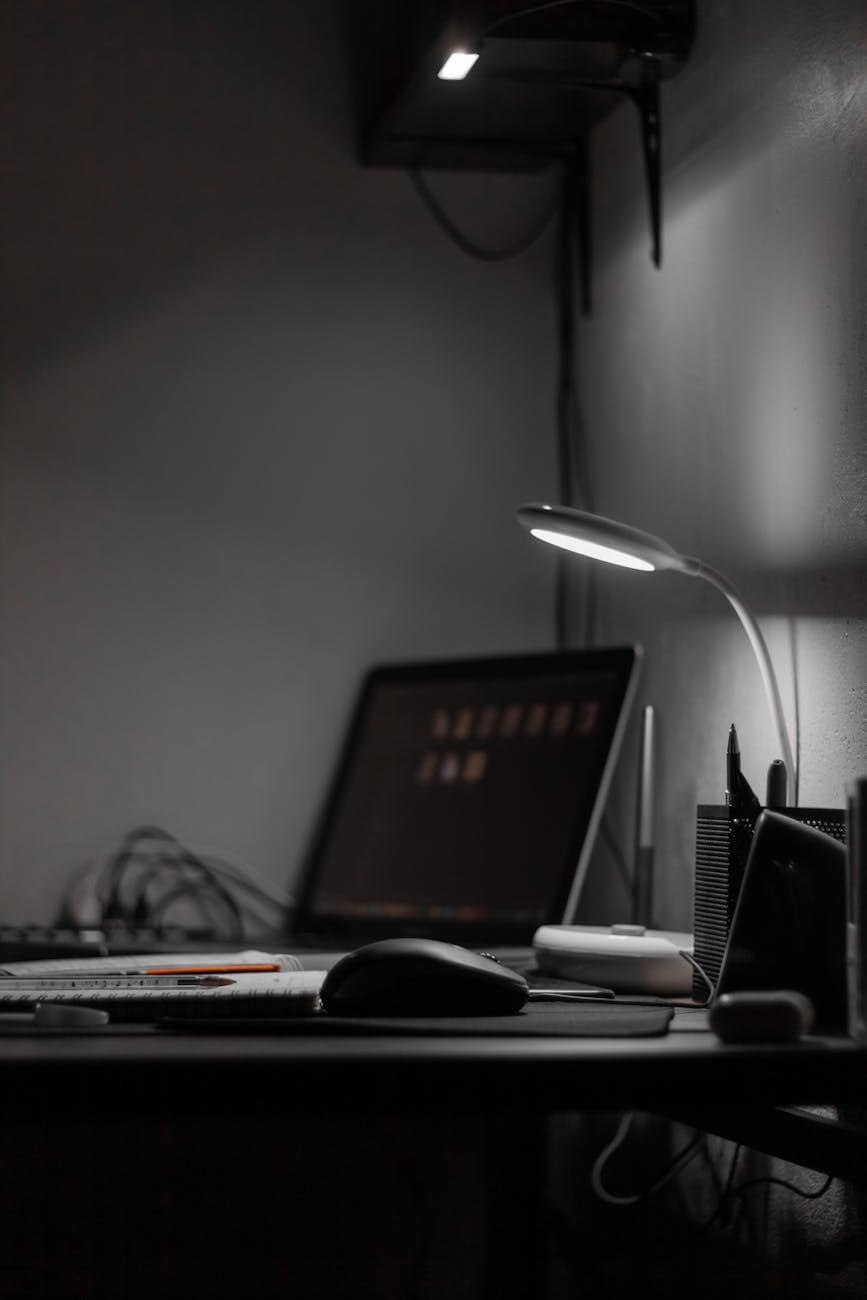
The Altar of the Modern Craft
There is a persistent romantic myth in literature: the “messy genius.” We’ve all seen the photos of famous authors surrounded by mountains of crumpled paper, overflowing ashtrays, and half-empty coffee mugs. We’ve been told that chaos is a sign of a fertile mind.
In 2026, we know better.
For the Sovereign Author, the desk is not just a piece of furniture; it is an altar. It is the interface between your internal imagination and the external world. If your interface is cluttered with old mail, tangled charging cables, and random objects, your brain is constantly spending “processing power” just to ignore them. This is called Cognitive Load, and it is the silent killer of the Flow State.
To master the 24-Hour AI Writing Cycle, you need a physical environment that acts as a “Focus Funnel.” Here is how to build a minimalist desk that dictates a high-end digital flow.
Heads up: Some of the links below are affiliate links. If you buy something through them, I get a small commission at no extra cost to you. It helps keep this site running and the coffee brewing. Thanks for the support!
The Principle of Visual Quiet
Every object on your desk is a notification. A pile of bills is a notification about your finances. A dirty mug is a notification about chores. A random toy or gadget is a notification about a distraction.
Minimalism isn’t about having nothing; it’s about having only the essentials.
- The “One-In, One-Out” Rule: For every new tool you bring to your desk (a new Mechanical Keyboard, a new Space Pen), one must leave.
- The Desktop Surface: Aim for 80% empty space. This empty space is “breathing room” for your thoughts. When you look down, you shouldn’t see tasks; you should see the stage where your story is about to perform.
Killing the “Digital Medusa”: Cable Management
Nothing destroys an Urban-Indie aesthetic faster than a “Medusa” of tangled white and black cables snaking across the floor. In 2026, cable management is a form of mental hygiene.
- Under-Desk Trays: Hide your power strips and bricks in a tray under the desk.
- Wireless Transitions: Whenever possible, use wireless peripherals (like the Keychron or Logitech MX series).
- The Psychological Impact: When your cables are hidden, your tools feel “weightless.” They feel like extensions of your intent rather than tethered appliances.
Lighting: Designing the “Urban Dusk”
Lighting is the most underrated tool in the Toolbox. Standard overhead “hospital” lighting is designed for efficiency, not creativity. To find the “Urban Ghost” of your story, you need to control the shadows.
- Task Lighting: Use a monitor light bar (like the BenQ ScreenBar) to illuminate only your workspace. This creates a “Pool of Light” effect, where the rest of the room fades into darkness, pulling your focus into the screen.
- Warmth: Use warm-toned LEDs (2700K – 3000K). This signals to your brain that it’s time for “Deep Work” and creativity, rather than “Admin Work.”
- The Mood: If you are writing Urban Noir, your lighting should reflect that. A single, focused light source creates the contrast that mirrors the atmosphere of your prose.
The Minimalist Checklist: Before & After
| Feature | The “Chaos” Desk | The “Sovereign” Desk |
| Surface | Cluttered with “stuff” | 80% empty, matte finish |
| Cables | Visible, tangled | Hidden, managed |
| Lighting | Harsh overhead / Blue light | Focused task light / Warm tones |
| Tools | Multiple distractions | Essential tools only |
| Sound | Open room noise | Noise-canceling headphones |
| Mental State | Fragmented, reactive | Deep, proactive flow |
The Centerpiece Strategy
Your desk should have one “hero” object. This is the item that signals to your brain: It’s time to write. For some, it’s a high-end Mechanical Keyboard with a specific tactile click. For others, it’s the reMarkable 2 lying exactly in the center of the desk mat. By having a singular centerpiece, you create a “Ritual of Entry.”
The Sovereignty of the Chair:
You cannot write a 1,500-word piece if your back is screaming. Invest in a chair that disappears. Like a good minimalist app, a good chair shouldn’t be “felt.” It should support you so perfectly that you forget you have a physical body, allowing you to exist entirely within the digital world of your story.
[Ready to fill your minimalist desk with the right digital tools? Revisit my guide on Minimalist Text Editors.]
My Take: The “Nightly Reset”
I have a Nightly Reset ritual. Before I leave my desk at 11 PM, I clear everything. I wash the mug. I align the keyboard. I hide any stray cables. When I sit down the next morning, the desk is a “blank canvas.” There is no “friction” between my morning coffee and my first sentence.
[The Quntis Monitor Light Bar – The ultimate lighting solution for writers who want to create a focus zone. Get it on Amazon.]
Under-Desk Cable Management Tray – Stop the Medusa once and for all. Check it out here.]

FAQ: The Minimalist Transition
1. Does a minimalist desk have to be expensive?
No. Minimalism is about subtraction, which is free. Start by removing everything that isn’t a tool for writing. You don’t need a $2,000 desk to have a minimalist environment.
2. What about “Sentimental Clutter” (photos, trinkets)?
Keep one. If you have ten photos of your cat, they become “visual noise.” If you have one, it becomes a meaningful anchor. Choose the one that inspires you most.
3. Is “Digital Minimalism” just as important?
Yes. Your physical desk and your “Digital Desktop” (your computer screen) should mirror each other. If your physical desk is clean but your computer desktop has 50 icons, you are still experiencing cognitive load.
[Organize your digital desktop and your life with the “Building a Second Brain” book by Tiago Forte – The definitive guide to digital organization. Get it on Amazon.]
Final Thought: Design Your Success
Your environment is a reflection of your commitment to the Modern Craft. When you take the time to design a minimalist workspace, you are telling yourself that your stories deserve a dedicated, distraction-free home.
Clear the clutter. Manage the cables. Control the light. Your best prose is waiting for the space to appear.
Leave a Reply