
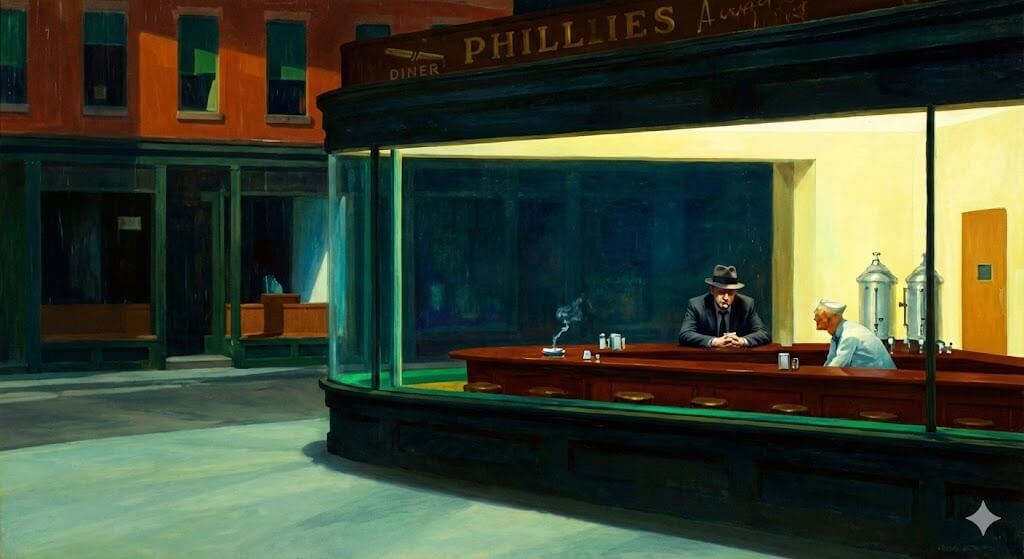
The Geometry of Isolation
If you look at an Edward Hopper painting, you don’t just see a scene; you feel a weight. It is the “urban melancholy” that arises not from an absence of people, but from their presence at the wrong distance. In his works, people inhabit the same space but exist in different universes.
For the Sovereign Author, this “Hopperesque” gaze is one of the most powerful tools in their Toolbox. Loneliness isn’t a void that needs to be filled; it is the “engine” that drives the narrative. It is the fuel for the hero’s Internal Need and the lens through which the reader perceives the truth of the city.
Heads up: Some of the links below are affiliate links. If you buy something through them, I get a small commission at no extra cost to you. It helps keep this site running and the coffee brewing. Thanks for the support!
Loneliness as “Internal Need”
Every self-respecting character has a Ghost and a Need. In an urban environment, loneliness is often the result of the Ghost and the driving force behind the Need.
- The Trap: The hero thinks they want to be alone (their “Want”).
- The Reality: Isolation forces them to confront their own shadows (their “Need”).
When using the “Hopperesque” approach, you don’t write “he was lonely.” You write about the distance between his hand and the phone that doesn’t ring. You write about how the neon light in his kitchen feels more alive than his own life. This solitude creates Tension that doesn’t require enemies with guns—it only needs the passage of time.
The Liminal Space: Writing the “Threshold”
Hopper’s paintings are filled with windows and doors. These are liminal spaces—the points where the “inside” meets the “outside.”
In the city of 2026, your hero is constantly in such spots: on the subway, in a late-night café, on the balcony of an Airbnb.
- The Strategy: Use these points to demonstrate disconnection. The hero watches the crowd through a window but is not part of it. They are an “observer” (the Flâneur we analyzed), but with a sting of pain.
- The Craft Tip: Describe the window not as glass, but as a filter that distorts reality. Loneliness is a lens that makes city lights look like distant stars.
Lighting the Void: Chiaroscuro of the Mind
Hopper was the master of light. His light is harsh, cold, and revelatory. In your prose, light must function the same way.
| Light Source | Narrative Effect | Psychogeographical Mood |
| Streetlamp | Highlights the “Lone Figure.” | Vulnerability / Exposure. |
| Neon Sign | Flickering, artificial, rhythmic. | Urban Decay / False Hope. |
| Morning Sun | Cold, long shadows, clinical. | The “Hangover” of existence / Clarity. |
| Laptop Screen | Blue light, isolation, digital ghost. | Modern Craft / Disconnection. |
Sudowrite Strategy: When describing an atmospheric scene, instruct the AI to focus on light and shadow.
The Prompt: “Describe the office at 3 AM. Use the lighting of an Edward Hopper painting. Harsh shadows, a single pool of artificial light, and the silence of the city pressing against the glass. Focus on the contrast between the warmth of the coffee and the coldness of the neon outside.”
The “Hopperesque” Scene Checklist
Before closing your next chapter, check if you’ve used loneliness as an “engine”:
- Is there physical distance? (Is there empty space in the room that emphasizes someone else’s absence?)
- Is there a visual barrier? (A window, smoke, a screen?)
- Is the character “performing” solitude? (Are they trying to look busy while the silence swallows them?)
- Is the city a silent witness? (Do the buildings seem to watch without judging?)

My Take: The Comfort of the Void
Many fear loneliness in writing because they think it will “bring the reader down.” I believe the opposite. “Hopperesque” loneliness is an invitation. The reader recognizes themselves in that silence.
When I sit at my Minimalist Desk at 2 a.m., I am not alone; I am part of a global community of people who stay up late, who observe, who try to find meaning within the neon. Loneliness is the “urban fabric” that connects us all. Don’t fear it. Write it. Make it the center of your world.
[Combine the “Hopperesque” atmosphere with POV techniques. Read my guide: The POV Masterclass: Psychic Distance.]
[“Edward Hopper: The Art and the Artist“ – The ultimate book to study the master’s composition and light. Get it on Amazon.]
FAQ: Writing the Silence
- How do I avoid loneliness becoming “boring”?
Loneliness becomes boring when there is no Internal Conflict. The hero must “struggle” with the silence. They must want to break it but fear the consequences. - Can a Noir story exist without loneliness?
Hardly. Noir is built on the isolation of the detective or the victim. Even in a crowded club, the Noir hero is alone—that is the essence of the genre. - Does AI help with atmosphere?
AI is excellent at “painting” with words. If you provide the right “Hopperesque” keywords (chiaroscuro, stark lighting, urban isolation), it will give you prose dripping with atmosphere.
Final Thought: Look Through the Window
The city is a collection of lit windows. Every window is a Hopper painting. Every painting is a story waiting to be written.
Don’t try to fill the void. Let the void speak. Use loneliness to show your reader what they cannot see in the light of day. Become the director of silence.

Leave a Reply