
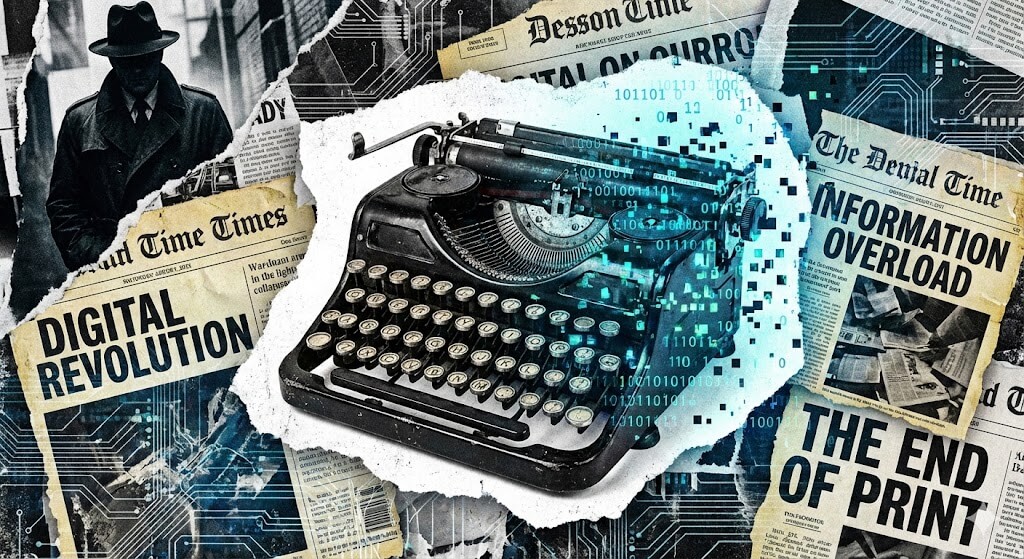
The Author as an Operator
In the Modern Craft of 2026, we often treat the AI Writing Assistant as a mysterious black box. We feed it prompts, and it spits out prose. But if we want to be truly Sovereign Authors, we need to understand that we are standing on the shoulders of giants—specifically, the giants who wanted to blow up the ivory tower of “Traditional Literature.”
Long before Large Language Models (LLMs) were “remixing” the internet to generate a draft, William S. Burroughs and the artist Brion Gysin were doing it with scissors and glue in a dirty room in Paris.
In 1959, Burroughs declared that “Writing is fifty years behind painting.” He saw that painters had embraced the collage and the abstract, while writers were still stuck in the linear, “polite” storytelling of the 19th century. His solution was the Cut-Up Technique. It wasn’t just a gimmick; it was a revolution. It was the first “manual” version of an AI draft.
Heads up: Some of the links below are affiliate links. If you buy something through them, I get a small commission at no extra cost to you. It helps keep this site running and the coffee brewing. Thanks for the support!
The Mechanics of the Cut-Up
The technique was simple, violent, and brilliant. You take a page of text (your own or someone else’s), cut it into four squares, rearrange them, and read the result.
Why did he do it?
- Breaking the “Conditioning”: Burroughs believed that language is a “virus”—a system of control that dictates how we think. By cutting up the text, he was “breaking the spell.”
- Discovering the Future: He noticed that when you rearrange words, you often find “inter-zones” of meaning—sentences that seem to predict the future or reveal hidden truths about the Urban Ghost.
- The “Third Mind”: When two writers’ works are cut up and blended, a “Third Mind” emerges. This is exactly what happens when you use a Voice Clone in Sudowrite. It’s not just you, and it’s not just the AI; it’s a new, hybrid creative entity.
From Scissors to Silicon – The Ancestry of AI
In 2026, we don’t need scissors. We have algorithms. But the philosophy remains the same.
When an LLM generates a response, it is essentially performing a high-speed, mathematical Cut-Up of its entire training data. It is looking for the most probable “next word” based on the patterns it has seen.
The Evolution of the “Virus”:
| Feature | The Burroughs Cut-Up (1960s) | The AI Draft (2026) |
| Tool | Scissors / Glue / Tape | Sudowrite / Neural Networks |
| Data Source | Newspaper / Rimbaud / Diaries | The entire digital history of humanity |
| Goal | Breaking linear control | Scaling creativity / Efficiency |
| Human Role | Curator / Assembler | Sovereign Editor / Conductor |
| Vibe | Low Life / High Concept | Neon Noir / Modern Craft |
The Connection: Burroughs’ goal was to bypass the conscious mind to reach a deeper “Automatic” truth. In the 24-Hour AI Writing Cycle, we do the same. We use the AI to give us “raw material” that our logical brain would never have thought of, and then we refine it with our unique human touch.
The “Reality Engineer” – How to Use Cut-Ups Today
As a Modern Author, you can use the spirit of the Cut-Up to inject “Urban Surrealism” and unexpected tension into your work.
1. The Digital Remix (Sudowrite Strategy)
Instead of asking the AI to “write a scene,” give it three unrelated paragraphs from your Obsidian “Second Brain” and use the Rewrite tool.
- The Prompt: “Act as a ‘Cut-Up’ operator. Blend these three distinct observations into a single, cohesive paragraph of urban noir. Do not follow a linear structure. Focus on the collisions of imagery.”
- The Result: You will get prose that feels “jagged” and “alive”—the opposite of generic AI output.
2. The “Word-Virus” Filter
If your prose feels too “polite” (a common AI trap), apply a Burroughs-inspired filter.
- Custom Instruction: “Replace 10% of the verbs with industrial or medical terminology. Break the sentence structure where the tension is highest. Introduce a glitch in the character’s perception of the city.”
3. The “Inter-Zone” Brainstorming
Use the Brainstorm tool to create a list of “impossible” urban details.
- Example: “A neon sign that smells like old blood.” “A subway train that travels through the character’s memories.”These are the types of images the Cut-Up technique was designed to find.

The Outlaw Philosophy of Sovereignty
Burroughs was an “Outlaw Author.” He didn’t care about the publishing industry’s rules. He didn’t care about “readability” in the traditional sense. He cared about Control—specifically, who has it and how to take it back.
In 2026, the Sovereign Author faces a new kind of control: the control of the “Platforms.”
- Amazon’s Algorithm is a form of linguistic control.
- Social Media is a form of attention control.
By embracing the Cut-Up mindset, we remind ourselves that we are Reality Engineers. Our job isn’t to please the algorithm; our job is to use these “calculating machines” to create something that feels dangerous, honest, and new. When you “cut up” the expectations of your genre, you create a space where you are truly in charge.
[Want to see how to apply this ‘outlaw’ mindset to your marketing? Revisit my guide: The ‘Burner’ Social Media Strategy.]
My Take: The Ghost in the Machine
After studying Burroughs, I realized that the AI is my “Brion Gysin.” It’s the partner that helps me see the patterns I’m too close to recognize.
When I run a “Digital Cut-Up” on a scene that feels stale, I’m not just being lazy; I’m “operating” on the reality of my story. I’m looking for the Urban Ghost that hides in the fragments. The 2026 author isn’t a “writer” in the 19th-century sense; we are technicians of the imagination.
[“The Naked Lunch” by William S. Burroughs – The definitive work of the Cut-Up era. A difficult, essential read for the modern craft. Get it on Amazon.
“The Third Mind” by Burroughs and Gysin – The ‘manual’ for the Cut-Up technique and the philosophy of creative collaboration. I only found it used so get it here.]

FAQ: The Cut-Up Protocol
1. Won’t my book be “unreadable” if I use this?
Burroughs used the technique for entire novels, which can be challenging. For the Modern Indie, I suggest using it for texture and inspiration. Use the Cut-Up to find that “one killer line” or that “impossible metaphor,” then weave it into a readable structure.
2. Is this plagiarism?
Not if you are cutting up your own work or using the AI’s generative power. The goal is “Transformation.” In 2026, the concept of “originality” has shifted from “who wrote the word” to “who curated the connection.”
3. Does this help with writer’s block?
It is the ultimate cure. If you can’t write, cut. Take your last page, run it through a “Shuffle” prompt, and see what the Third Mind gives you. You’ll be back in the Flow State in five minutes.
Final Thought: Break the Spell
The city of 2026 is a giant, interlocking system of words and code. As authors, we are either the “subjects” of that system or its “operators.”
Don’t be afraid of the “glitch” in your prose. Don’t be afraid of the AI’s “random” suggestions. Use them as scissors. Cut the page. Rearrange the city. Find the “Third Mind.” Like Burroughs, remember that the only way to find the truth is to break the language that is hiding it.
Leave a Reply